Miniaturized Navigation System for Computer Aided Surgery
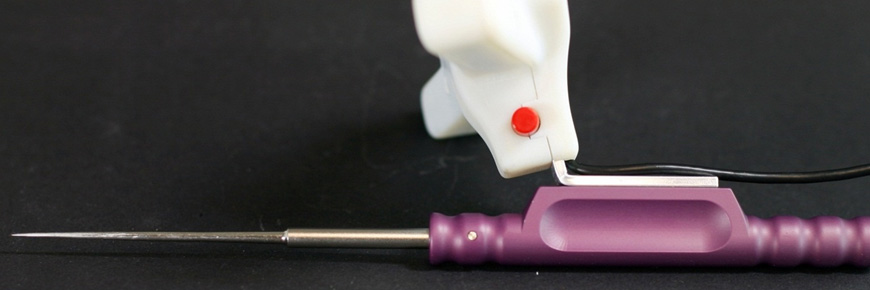
Currently existing optical navigation systems have ergonomic disadvantages such as size, the “line of sight” problem and extended registration procedures. A miniaturised System fixed directly to the surgical tool could overcome these problems.
Navigated surgery has become a state-of-the-art method in many surgical interventions. The challenge is that navigation systems are integrated into the complex OP environment and the demands to the system are different concerning space, accuracy and functionality. Therefore existing systems have ergonomic disadvantages such as size, “line of sight” problem and extended operation time.
Development of a measuring and navigation system which corresponds to the requirements of current and future operation rooms. Special emphasis is placed on measured and recorded quality control and new workflows which reduce the operation time. By combining the precise measurement of new type of markers with surface scanning the registration process can be shortened substantially. In addition the three dimensional position of surgical implants can be determined with a few measurements only, which allows to simplify many surgical work flows.
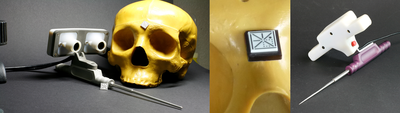
The total development of the measuring system, consisting of two 5-megapixel cameras was successful. Users (surgeons) and suppliers of surgical implants, who have been exposed to the system, have expressed their keen interest, as it opens up new applications and fulfills their needs for improved ergonomics and smarter, cost reducing work flows.
A miniaturized measuring and navigation system with high resolution cameras has been developed and tested.
Based on a cheap manufacturing process biocompatible markers have been produced. They can be characterized by high precision (4µm), high contrast and autoclavability.
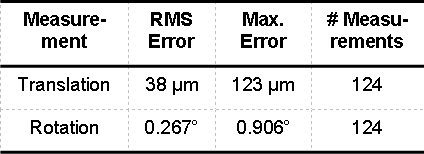
Accuracy:
Software Application:
- for maxillofacial restoration osteotomy is ready for
further tests - for hip replacement is available or unicondylar knee
replacements.
Algorithms and a corresponding software application have been developped and tested in an ex vivo study.
Clinical trials will be carried out at the University Hospital Basel and Bruderholzspital.
Next steps focus on improvements in:
- measurement speed (up to 10 measurements per second),
- accuracy,
- automatic calibration and Registration
Download as pdf.